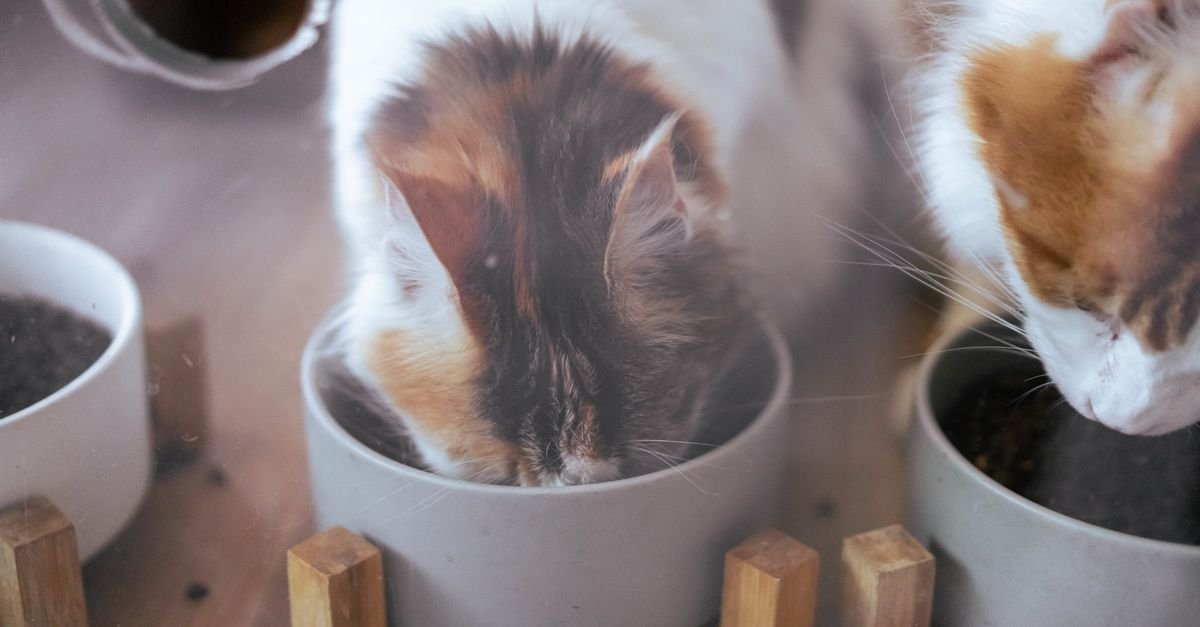
Yes—you can feed multiple cats separately without supervising every bite. The most reliable setup gives each cat an individual portion and a feeding location where the other cat cannot easily interfere. In smaller homes, doors, visual barriers, timed feeders, and individual-access feeders can create useful separation without requiring a separate room for every cat.[2][4]
Food stealing is not always an obvious fight. One cat may rush through a meal, hover beside another bowl, block access, stare, or repeatedly leave and return to eat. If one cat can approach or monitor another cat’s bowl, increasing distance or adding a visual barrier can make it easier for both cats to eat their own portions.
Why shared bowls and open feeding often fail
A shared bowl makes it difficult to know how much each cat has eaten. That matters when cats have different calorie needs, body conditions, or diets. Separate bowls also make it easier to notice when one cat suddenly eats less than usual.[2]
Leaving food available all day can create a second problem: you may not know which cat ate the food, how much was consumed, or whether one cat is regularly pushing another away. Free-choice feeding may work for some cats, but it can be harder to manage when one cat steals food or when meals need to be measured.[3]
The basic separate-feeding setup
- Measure each cat’s daily food. Divide the daily amount into the meals you plan to offer. Use the feeding guidance on the food label as a starting point, then ask your veterinary team if your cat needs an individualized amount.
- Give each cat its own bowl or feeder. Do not rely on one communal dish if competition is already happening.
- Choose locations that prevent interference. The cats should not be able to crowd one another, guard the bowls, or reach across to steal food.
- Use visual separation whenever possible. A closed door is best, but a furniture screen, tall cardboard panel, covered baby gate, or positioning around a corner can also help if it prevents either cat from reaching the other’s food.
- Remove leftovers after a planned meal window. This prevents one cat from returning later to finish another cat’s portion. For wet food, follow safe food-storage practices and your veterinarian’s advice.
International Cat Care describes providing cats in a multi-cat home with individual puzzle feeders and separate feeding locations as ways to support feeding and foraging needs. The goal is not to make every meal complicated; it is to give each cat a fair opportunity to eat without competition.[1]
Small-space solutions for separate feeding
You do not necessarily need two full rooms. Start by identifying places where each cat can eat without being cornered or able to reach the other cat’s bowl.
| Space problem | Practical setup | Important limitation |
|---|---|---|
| Only one main room | Feed one cat on one side of a closed interior door, then switch locations for the next meal if needed. | Do not leave a cat trapped without access to water, litter, or a comfortable space. |
| No spare room | Use a hallway corner, bedroom entrance, or furniture arrangement that blocks direct access and, when helpful, direct eye contact. | Make sure neither cat can walk around the barrier and commandeer the other bowl. |
| One cat climbs well | Place one cat’s bowl on a stable, elevated surface that the other cat cannot safely access. | Only use elevated feeding if the cat can reach it comfortably and the surface is secure. |
| Meals happen while you are away | Consider timed feeders or feeders that open for an individual microchip. | Test the device while you are home; some cats need time to learn how to use it. |
| There is no room for multiple bowls | Use shallow individual dishes and rotate feeding locations while keeping the cats out of reach of one another. | Do not place food beside litter boxes or in a high-traffic, noisy area. |
For many homes, the easiest starting arrangement is one cat in the kitchen and one in a bedroom or bathroom for the length of the meal. Once both cats finish calmly, you can experiment with a less restrictive visual barrier. If tension or food stealing returns, go back to the arrangement that worked.
How to use puzzle feeders without creating more competition
Puzzle feeders can slow eating and add foraging activity, but they should not become another resource the cats fight over. Give each cat its own feeder, use an easy difficulty level at first, and place the feeders far enough apart that one cat cannot monitor or take over both.[1][5]
Begin with part of a familiar dry-food meal rather than the entire daily ration. Watch how each cat interacts with the feeder. If a cat does not understand it, scatter a few pieces beside the feeder or use a simple design with large openings. For wet food, choose a feeder made for moist diets and clean it promptly.
Supervise new food toys initially. Some cats may guard a novel or especially valuable feeder. If one cat becomes tense, blocks access, growls, swats, or abandons the meal, increase the distance or use closed-door feeding instead.[5]
A simple routine that reduces food stealing
- Prepare and measure both portions before calling the cats to eat.
- Place each cat in its feeding zone before setting down the food.
- Keep the separation in place for the whole meal, not just until the faster cat finishes.
- Use the same general locations and schedule so the routine is predictable.
- Pick up bowls after the meal window ends.
- Record unusual leftovers, rapid eating, or repeated attempts to reach the other cat’s food.
If one cat eats quickly, divide that cat’s daily ration into smaller meals or offer part of the meal in a suitable puzzle feeder. Some feline feeding guidance supports offering food in ways that encourage foraging and activity; use an approach that suits the individual cat and does not create competition.[4][5]
Signs your setup needs more separation
Increase the distance or add a visual barrier if you notice:
- One cat staring at, blocking, or walking toward the other cat’s bowl
- Rapid gulping, crouching, flattened ears, or repeatedly looking around while eating
- One cat waiting until the other leaves before approaching food
- Food being abandoned even though the cat usually eats readily
- Chasing, swatting, growling, or guarding around feeding areas
These signs mean the cats may not feel secure enough to eat comfortably. Feeding them in separate rooms is often more effective than repeatedly moving bowls closer together or correcting the food-stealing cat.
When to ask for professional help
Contact your veterinarian if a cat’s appetite changes suddenly, if weight is changing unexpectedly, or if one cat is routinely eating little or nothing. A feeding problem can sometimes overlap with a health problem, and separate feeding makes these changes easier to detect. If the cats are injuring one another or conflict continues outside mealtimes, ask your veterinary team about a behavior plan rather than trying to force shared meals.
For broader household strategies, see our guide to setting up a cat-friendly home in a small space. If food-related tension is part of a wider relationship problem, our guide to starting over when cat introductions stall may also help.
The five-minute setup check
Before the next meal, ask: Does each cat have its own measured portion, can either cat reach the other’s food, and can each cat eat without direct visual pressure? If the answer to any question is no, add one simple change—usually a closed door, a visual barrier, greater distance, or an individual feeder. Small adjustments made consistently are often enough to turn tense meals into a predictable routine.
Sources
- Five-a-day Felix report — International Cat Care
- Feeding Multiple Pets — VCA Animal Hospitals
- Nutrition - General Feeding Guidelines for Cats — VCA Animal Hospitals
- Feline Feeding Programs: Addressing Behavioral Needs to Improve Feline Health and Wellbeing — Feline Veterinary Medical Association
- Behavior Management - Enrichment and Activity Toys — VCA Animal Hospitals