
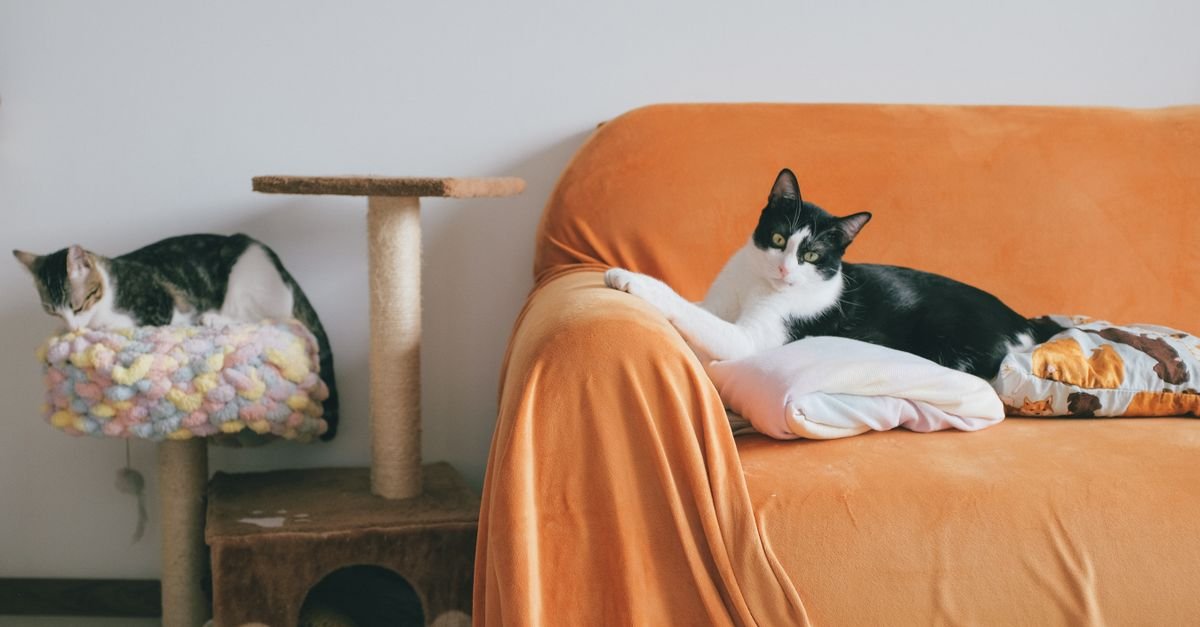
The fastest way to stop couch scratching is usually not to remove the scratching behavior—it is to give your cat a more appealing place to perform it. Put a suitable scratcher directly beside the damaged area, match its orientation and texture to your cat’s habits, reward its use, and temporarily protect the couch. Avoid yelling, spraying or physically moving your cat as punishment.
Scratching is normal feline behavior. Cats use it to stretch, maintain their claws and leave visual and scent marks from their paw pads.[1] That is why a scratcher hidden in a quiet corner may lose to the couch: the couch is prominent, familiar and often located where the household spends time.
Why your cat may ignore the scratching post
A scratching post is not automatically attractive just because it is sold as a cat product. Your cat may be rejecting a mismatch rather than rejecting scratchers altogether.
- Wrong orientation: Some cats prefer to scratch upright, while others prefer a flat cardboard pad or another horizontal surface. A cat that scratches rugs may be more likely to choose a horizontal scratcher.
- Wrong height: A vertical post should allow your cat to stretch fully while standing on the hind legs. If it is short or wobbly, it may not provide the satisfying stretch your cat wants.[1]
- Wrong texture: Cats differ in whether they prefer sisal, corrugated cardboard, carpet, wood or fabric. Many like a surface that lets the claws catch and pull.
- Wrong location: A scratcher placed behind a door or in an unused room may be less useful than one beside the couch, near a sleeping area or along a well-used route.
- Unpleasant previous experience: If a post tips over, makes an alarming noise or is associated with being grabbed, your cat may avoid it.
Think of the couch as a clue. Its height, fabric, angle and location tell you what your cat is currently choosing. Use those details to select the replacement.
A furniture-protection plan that works
1. Place the new scratcher beside the couch
Start with the easiest location for your cat, not the most convenient location for your décor. Put the scratcher directly in front of the couch corner or arm your cat targets. This blocks access and gives your cat an immediate alternative.
Once your cat is using it consistently, move it only a few inches at a time. If scratching decreases after a move, return the scratcher to the last successful position. Cats often scratch prominent areas to leave a territorial message, so a hidden replacement may fail even when its design is good.[1]
2. Match the angle and texture
If your cat stands and reaches up the couch, begin with a stable vertical post or wall-mounted scratcher. Choose one tall enough for a full-body stretch. If your cat scratches the front of a rug, the floor or a couch cushion, offer a horizontal pad. For a cat that targets a couch corner, a corner-style scratcher may provide a closer physical match.
When you are unsure, offer a small “test station” with two or three options: one tall sisal post, one horizontal cardboard pad and one alternative material such as wood or carpet without loose loops. Observe which one your cat chooses rather than assuming that the most expensive option will be best. International Cat Care also notes that a horizontal surface may be more comfortable for some cats, including cats for whom a tall vertical post is painful.[2]
3. Make the post stable
A scratcher should not slide, tip or fold when your cat leans into it. Stability matters especially for larger cats and for vertical posts. Anchor a tall post according to the manufacturer’s instructions, or choose a heavier base. A scratcher that moves during use can quickly become unattractive.
4. Reward the choice you want
When your cat uses the scratcher, calmly offer a small treat, praise or a brief play session. Rewarding after the behavior helps create a positive association. You can also place a favorite toy nearby or use catnip if your individual cat responds to it.
Do not drag your cat’s paws across the scratcher. Some cats find this frightening or intrusive, and it does not teach them why the object is useful. Instead, make the scratcher interesting and allow your cat to approach it voluntarily.
5. Protect the couch while habits change
Cover the targeted area temporarily with a tightly secured throw, furniture protector or another safe barrier. You can also rearrange the couch or place the scratcher so it physically blocks the favorite corner. The goal is to reduce access while the alternative becomes established—not to create a startling trap.
Check any cover or tape regularly so it cannot become a chewing, tangling or ingestion hazard. Avoid deterrents that could hurt, frighten or punish your cat. A punishment may stop scratching while you are present but can increase fear and does not teach a better outlet.[1]
What to do when you catch your cat scratching the couch
- Stay calm and avoid shouting or chasing.
- Place or guide the scratcher next to the target if it is not already there.
- Use a toy or gentle movement to invite your cat toward the scratcher.
- Reward the cat if it scratches the approved surface.
- Increase couch protection if the cat immediately returns to the same spot.
If your cat is highly aroused, do not force an interaction. Simply block access after the cat moves away and improve the setup before the next opportunity.
How many scratchers does a cat need?
There is no single correct number. One cat may use one well-placed post; another may need several scratchers in different rooms. Provide options near the places your cat sleeps, enters a room, plays or repeatedly scratches. A cat may want one surface for a morning stretch and another for marking a busy living area.
Pairing scratching options with broader enrichment can also help, particularly when scratching increased after a household change or when your cat seems restless. Interactive play, elevated resting areas, hiding places and rotating toys can make the home more engaging. For additional ideas, see enrichment ideas for indoor cats.
Should you trim the claws?
Routine claw trimming may reduce the sharpness of the tips, but it does not replace a scratching outlet. Cats still need to stretch, maintain their claws and mark their environment. If you trim claws, learn the technique from a veterinary professional or experienced groomer, and stop if your cat becomes distressed.
Never declaw a cat as a furniture-management shortcut. Declawing removes the end bones of the toes and does not address the underlying need to scratch.[5]
When couch scratching may signal a bigger problem
A sudden increase in scratching, scratching at many new locations, or scratching that appears alongside hiding, aggression, appetite changes or urine marking can occur with household stress. Consider recent changes such as a move, a new person or animal, construction noise or a changed schedule. Multiple cats may also need more separated resources and resting areas. If tension followed the arrival of another cat, this guide to introducing a new cat may help.
Also distinguish furniture scratching from skin itching. If your cat is repeatedly scratching its body, biting or licking the skin, losing hair, developing scabs or showing redness, contact a veterinarian. Itching is a sign rather than a diagnosis, and common causes include parasites, infections and allergies.[4]
The practical takeaway
Do not ask your cat to stop scratching. Ask which part of the couch is appealing, then reproduce that feature with a stable scratcher in the same important location. Start with the couch-side placement, offer more than one orientation or texture, reward use and protect the furniture during the transition. If one scratcher fails, treat that as useful information—not proof that your cat cannot be redirected.
A seven-day setup test
- Day 1: Photograph the couch target and note its angle, texture and location.
- Day 2: Place a matching scratcher directly beside it.
- Days 3–4: Add a second orientation or texture if the first is ignored.
- Days 5–6: Reward every voluntary use and keep the couch covered.
- Day 7: Keep the option your cat uses most and move it only gradually, if necessary.
Sources
- Cat Behavior Problems: Scratching Behavior — VCA Animal Hospitals
- Cat Caregiver Guide: Home Modifications — International Cat Care
- Top 15 Tips for Keeping Your Cat — The Humane Society of the United States
- Itching (Pruritus) in Cats — Merck Veterinary Manual
- Declawing Cats: What You Should Know — American Veterinary Medical Association