
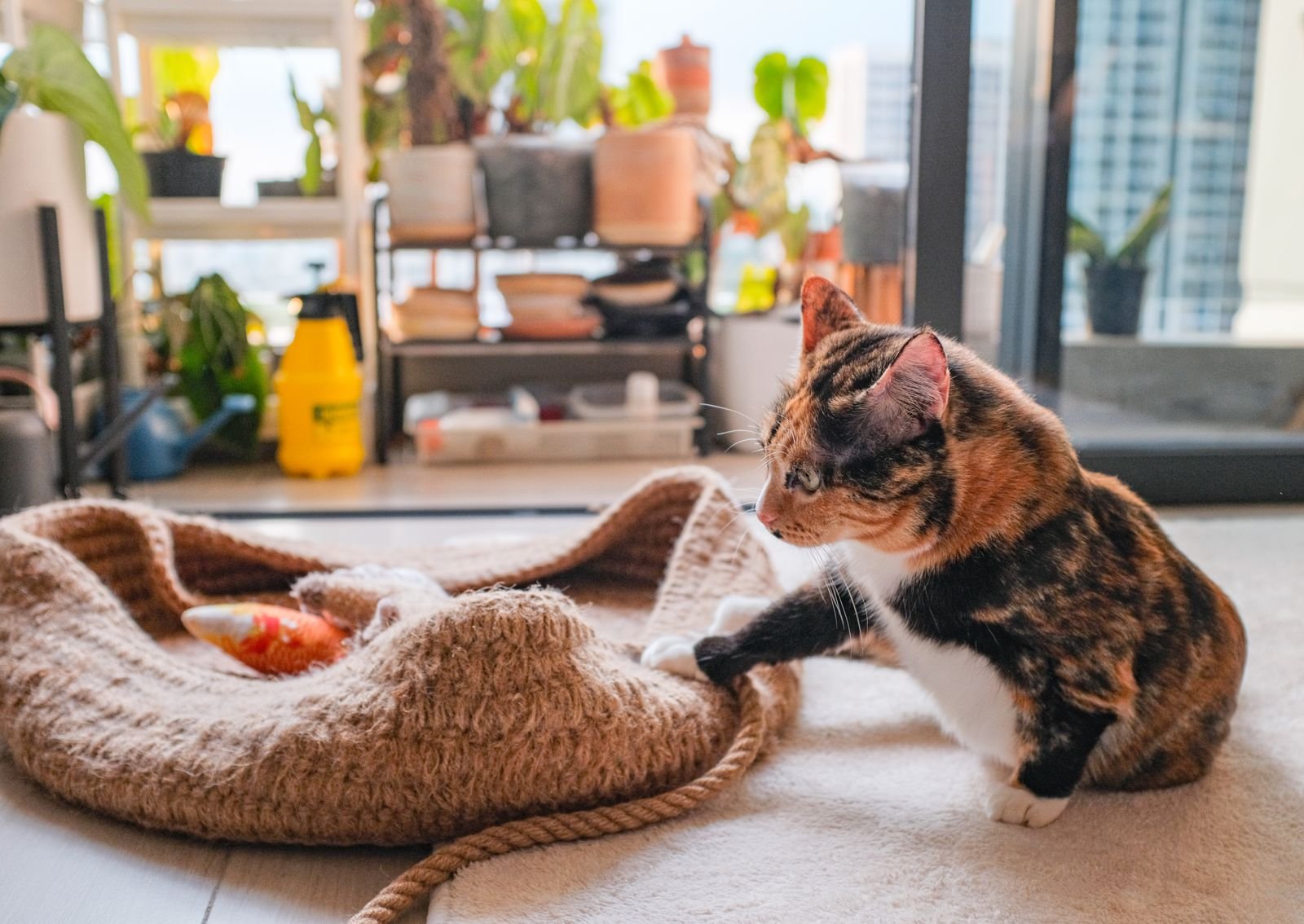
Yes—an indoor cat can become bored, especially when the daily environment offers little variety. Nighttime zoomies, persistent attention-seeking, destructive scratching or chewing, and sudden interest in forbidden objects may reflect unmet needs. However, a new or worsening behavior should not automatically be blamed on boredom; pain, illness, anxiety or household stress can look similar and may need veterinary attention.[1][3]
The practical solution is not to buy a pile of toys. Build a rotating enrichment menu that gives your cat regular opportunities to stalk, chase, catch, climb, scratch, hide, investigate and work for part of a meal. These activities can be adapted to a small apartment and made with ordinary household items.
Supervise household-item enrichment. Remove and discard boxes, bags, paper, homemade puzzles or other items if your cat chews or shreds them, if pieces go missing, or if the item becomes unstable or damaged. Check setups regularly for loose parts and ingestion hazards.
Start with the five needs behind good enrichment
Use your cat’s natural behavior as the planning guide:
- Hunting: stalking, chasing, pouncing and catching a moving object.
- Foraging: searching for food rather than receiving every meal in one predictable bowl.
- Climbing and observing: reaching elevated, secure places to rest and watch the room.
- Hiding and resting: choosing a quiet retreat when your cat wants privacy.
- Scratching and scent-marking: using appropriate surfaces to stretch, maintain claws and leave scent.
Indoor enrichment works best when it provides choice and does not force interaction. Some cats prefer energetic chase games; others would rather investigate a paper bag, watch activity from a shelf or search for scattered kibble. Hunting-style play, food puzzles, vertical space and hiding areas are all recognized ways to support species-typical feline behavior.[2][4]
A rotating enrichment menu for real homes
Offer a small selection each day, then change the combination rather than leaving every item out all the time. The following menu is a starting point, not a rigid schedule.
| Day | Main activity | Simple setup |
|---|---|---|
| Monday | Interactive hunt | Use a wand toy to imitate prey: move it away, pause, hide it briefly and let your cat catch it at the end. |
| Tuesday | Food search | Hide small portions of your cat’s regular food in several easy-to-find locations around one room. |
| Wednesday | Box investigation | Place a clean cardboard box on its side with a folded towel or a toy inside. Rotate its position later. |
| Thursday | Climb and observe | Clear a stable cat tree, shelf or window perch. Add a route using a lower box or step if needed. |
| Friday | Scratching circuit | Offer a vertical scratcher near a preferred scratching spot and a horizontal scratcher in another area. |
| Saturday | Foraging challenge | Use a food puzzle or an open cardboard egg carton with a few pieces of regular dry food placed in separate cups. |
| Sunday | Choice day | Set out two familiar options and let your cat decide: a hiding place, a toy, a perch or a food search. |
Value check: Aim to provide at least one hunting, one foraging, one climbing or observing, and one resting or hiding opportunity across the day. You do not need to complete every activity daily.
Make play resemble a hunt
A wand toy is most useful when it behaves less like a waving object and more like something trying to escape. Move it along the floor, behind furniture or around a corner. Alternate quick movements with pauses, because stalking includes waiting and watching. Let your cat catch the toy periodically.
Short sessions are often easier to fit into a routine than one long session. Try several brief play periods, particularly before a meal or at times when your cat usually becomes active.[1]
Never encourage a cat to attack hands or feet. Keep string, ribbon, elastic and wand toys stored away when you are not supervising; swallowed strands can be dangerous. Choose toys that are large enough not to be swallowed and inspect homemade items for loose pieces.
Turn meals into safe foraging
Food enrichment can add mental work without adding calories. Use part of your cat’s normal daily ration in a puzzle feeder, treat ball, paper cups or several small hiding spots. Start with the food visible and the challenge easy. Once your cat understands the game, make the food slightly harder to reach or vary the location.
Change locations gradually and keep the first searches within an area your cat already uses. Some cats may enjoy food placed on a low cat tree or stable shelf, while others need all food kept on the floor. Do not place food near the litter box, in unsafe locations or where another pet can guard it. Puzzle feeding should replace part of a meal—not become an extra source of calories.[2]
Use household items to create exploration
Cardboard boxes and paper bags
Put a plain cardboard box on its side, cut two large doorways or combine two boxes into a short tunnel. A paper bag can provide a new texture and hiding place, but remove handles first. Move the setup to a different safe location after a few days, or add a familiar blanket to make it more appealing. Supervise these items and discard them if they are chewed, shredded, damaged or missing pieces.
Window watching
A secure window perch can add visual stimulation. Keep windows screened and secure, and avoid placing a perch where a fall is possible. If outdoor animals trigger agitation, staring, urine marking or redirected aggression, reduce the view or move the perch.
Climbing without a major remodel
A stable cat tree, cleared bookcase section or sturdy furniture route can provide useful vertical space. Cat trees, bookcases, shelves and other climbing surfaces or furniture must be securely anchored or otherwise stabilized, and capable of supporting your cat’s weight without wobbling, tipping or collapsing. Test anything your cat may jump on, and remove exposed cords or fragile objects. Older, overweight or mobility-limited cats may need low steps and wide resting platforms rather than tall jumps.
Scratching choices
Place a scratcher close to the furniture your cat already targets. Offer more than one orientation: some cats prefer a tall vertical surface, while others choose a horizontal cardboard pad. A scratcher should remain stable during use; if it moves, your cat may abandon it. Scratching is normal behavior, so redirecting it works better than punishment.[3]
What to do if your cat ignores the enrichment
- Lower the difficulty. Put food puzzles in their easiest setting and make toys move slowly.
- Change one variable. Try a new location, texture, height or time of day instead of replacing everything at once.
- Follow preference. If your cat likes watching rather than chasing, prioritize a secure perch and brief, low-pressure games.
- Use familiar scents. A blanket or toy that already smells like home may make a new box or carrier less intimidating.
- Keep novelty limited. Too many changes can be stressful. Rotate a few options and return favorites later.
When “boredom” may be something else
Contact your veterinarian if destructive behavior, vocalization, hiding, overgrooming, aggression, appetite changes or litter-box problems appear suddenly, become intense or continue despite reasonable enrichment. Medical problems can contribute to behavior changes, and environmental enrichment should complement—not replace—an appropriate health assessment.[1][3]
The goal is not to keep your cat constantly busy. A successful indoor routine gives your cat predictable care, safe choices and regular chances to perform normal feline behaviors. Start with one short hunt, one food search and one improved resting or scratching area, then rotate from there.
Sources
- Cats and Play — Cats Protection
- Five-a-Day Felix — International Cat Care
- Feline Behavior Problems: Destructive Behavior — Cornell University College of Veterinary Medicine
- A Guide to Creating a Cat Friendly Clinic: Part 2 — International Cat Care