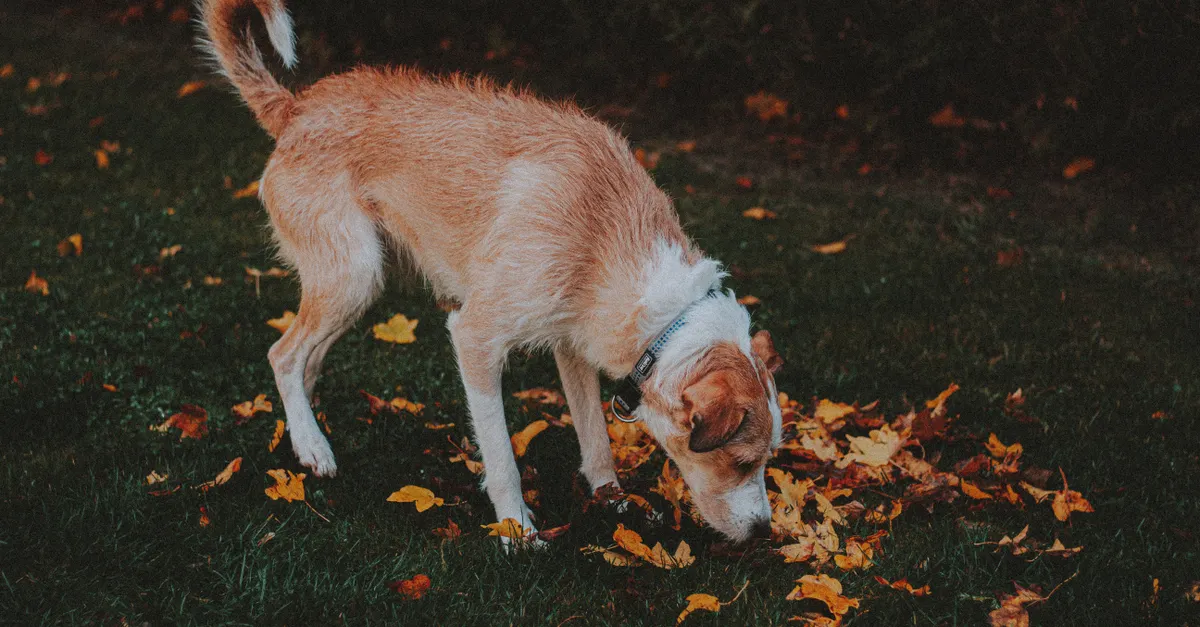
To calm an overexcited dog, do not automatically add more intense exercise. Fast fetch, rough play, busy dog parks, and repeated high-energy games can make some dogs fitter without making them better at settling. A more useful plan combines appropriate movement with lower-pressure activities—such as sniffing, foraging, chewing, and brief reward-based training—followed by a predictable transition into rest.
The goal is not to suppress normal excitement. It is to help your dog move from activation back to a state in which they can eat, think, respond to cues, and relax.
Activation is not the same as decompression
Enrichment is any safe activity that lets a dog engage with meaningful physical, sensory, social, or problem-solving opportunities. But enrichment can affect arousal in different ways.
| Type of experience | What it may look like | What to watch for |
|---|---|---|
| Activation | Chasing, sprinting, intense tug, rapid-fire tricks, exciting greetings | More jumping, barking, grabbing, frantic movement, or difficulty stopping |
| Decompression | Sniffing at the dog’s pace, easy foraging, licking, chewing, quiet exploration | Slower movement, softer body language, ability to disengage, resting afterward |
| Overload | Too much novelty, noise, social pressure, or physical intensity | Vocalizing, pacing, mouthing, scanning, inability to take food, or escalating frustration |
These categories are a practical training framework, not a diagnosis. The same activity can activate one dog and help another decompress. A food puzzle may settle a dog who enjoys problem-solving but frustrate a dog who is already too aroused to work. A sniff walk may be calming in a quiet area but overwhelming beside traffic, dogs, or playground noise.
Why more exciting play may not calm your dog
High-energy play is not inherently bad. Running, chasing, tugging, and retrieving can provide useful exercise and social interaction. The problem is using stimulation as the only answer to every episode of overexcitement.
When a dog repeatedly rehearses explosive starts, frantic chasing, barking for the toy, or rough grabbing, the dog may be practicing arousal without practicing recovery. They may finish physically tired but still unable to settle. That is why the most useful question is not only “How tired is my dog?” but also “Can my dog transition out of the activity?”
“Calm” does not mean that every slow activity works immediately, and “active” does not mean that every energetic game makes arousal worse. Your dog’s response and ability to recover are the important feedback.
A calmer daily enrichment menu
Use your dog’s regular food when practical, and reduce meal portions as needed so enrichment does not unintentionally add excess calories. Introduce each activity in a quiet setting before using it around distractions.
1. Sniffing and free exploration
Try a short, low-pressure sniff walk in a quiet area. Let your dog investigate safe smells instead of turning the walk into a distance or speed challenge. You can also scatter part of a meal across grass, a snuffle mat, or a securely enclosed area.
Stop or simplify the activity if your dog begins searching frantically, repeatedly scans for triggers, cannot take food, or becomes more agitated afterward. These observations are practical signs that the environment or task may be too difficult for that dog at that time.
2. Foraging and licking
Offer kibble in a scatter feed, a simple food-dispensing toy, or a shallow snuffle setup. For a dog who is new to puzzles, make the food easy to access. Difficulty should increase gradually, not because frustration is supposed to be tiring, but because successful problem-solving keeps the activity manageable.
Food-based enrichment can be especially useful before a predictable settling period—for example, after a walk and before household activity resumes. Choose an option your dog can use successfully and monitor whether it leaves them more settled or more frustrated.
3. Chewing and quiet occupation
Some dogs settle best with an appropriate chew or a frozen food toy. Supervise chewing, select products suited to your dog’s size and chewing style, and remove anything that splinters, breaks apart, or creates a choking risk. If chewing causes guarding, frantic destruction, or conflict with other pets, use a different activity and ask a qualified professional for help.
4. Short, low-pressure training
Practice behaviors that support transitions: touching your hand, going to a mat, standing calmly for a harness, looking toward you, or releasing a toy. Keep sessions brief and reward soft, steady responses. If your dog begins snatching treats, vocalizing, jumping, or missing easy cues, lower the difficulty or end the session.
Reward-based training is recommended by the American Veterinary Society of Animal Behavior. Its guidance emphasizes teaching the dog what to do, arranging the environment to prevent unwanted rehearsal, and avoiding force, pain, or intimidation.[1]
The transition routine matters
Many dogs become frantic because enrichment ends abruptly and the next expectation is unclear. Build a repeatable transition:
- Choose a stopping point before play begins. End while your dog can still respond, rather than waiting for a meltdown.
- Lower the environment. Put away the toy, reduce noise, close the window if outside activity is triggering, and create distance from other pets.
- Offer a simple recovery activity. Use a scatter feed, lickable food toy, chew, or quiet sniffing opportunity.
- Guide—not force—a rest location. Reward your dog for choosing a mat, bed, crate, or quiet room if that area is already positive and comfortable.
- Protect the rest period. Avoid immediately restarting play, greeting guests, or adding more commands.
A useful rule is: one activating activity should be followed by one recovery opportunity. For example, pair a short game of fetch with a sniff scatter and a quiet rest period. The exact duration depends on the dog; a few minutes may be appropriate for one dog, while another needs a longer wind-down.
A practical seven-day starting menu
| Day | Primary enrichment | Transition |
|---|---|---|
| 1 | Quiet sniff walk | Scatter feeding at home, then rest |
| 2 | Easy food toy using part of a meal | Mat reward for two to five minutes |
| 3 | Short tug or fetch session | End cue, water, chew, quiet room |
| 4 | Foraging in grass or on a snuffle mat | Low-noise rest period |
| 5 | Brief reward-based training | Food scatter and no further demands |
| 6 | Sniff walk in a slightly different quiet location | Home decompression with a food toy |
| 7 | Repeat the activity that produced the best recovery | Keep the same transition routine |
Track three things: arousal before the activity, behavior during the activity, and recovery afterward. A simple note such as “more settled within 15 minutes” is more useful than assuming that a longer or harder activity is automatically better.
When to change the plan
Reduce intensity and increase distance from triggers if your dog is repeatedly unable to take food, becomes more frantic after enrichment, mouths people, redirects onto another pet, or cannot settle despite a predictable routine. Do not use punishment, forced restraint, or confrontation to make an aroused dog “calm.” Those approaches can increase fear or conflict and do not teach a reliable recovery behavior.[1]
If the change is sudden, severe, linked with pain, or accompanied by aggression, panic, compulsive behavior, or repeated inability to rest, arrange a veterinary assessment. A veterinarian can help identify medical contributors and refer you to an appropriate behavior professional when needed.
The takeaway
The best enrichment routine for an overexcited dog is not the one that produces the most dramatic activity. It is the one that meets the dog’s needs while preserving the ability to recover. Mix movement with sniffing, foraging, chewing, and short reward-based training. End before arousal peaks, make the transition predictable, and judge success by what happens after the activity.
For one week, score each activity by both enjoyment and recovery. Keep the activities that your dog enjoys and can leave calmly; modify or replace activities that create more frantic behavior afterward.
Sources
- Position Statement on Humane Dog Training — American Veterinary Society of Animal Behavior
- How to Stop Dog Barking at Night — Ruvza Pet