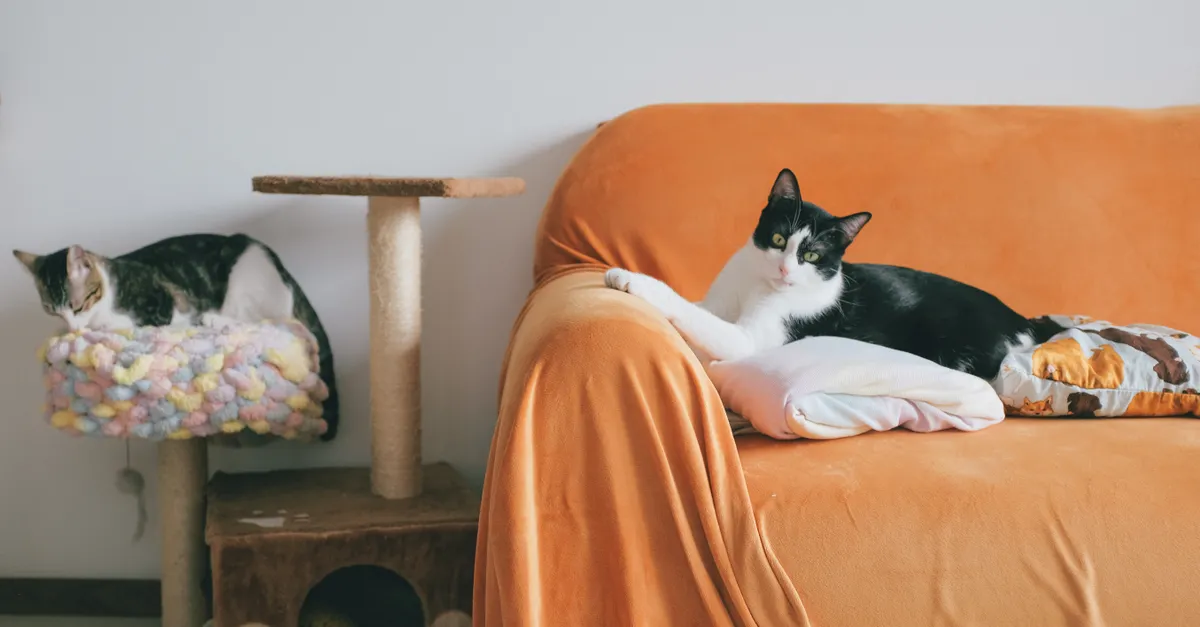
If two cats are still hissing, chasing, swatting, or fighting after weeks or months, stop giving them unrestricted access and restart the introduction. Do not let them “fight it out.” Cats generally do not resolve household conflict through repeated fights; each incident can increase fear, defensive behavior, and anticipation of the next attack.[1]
The reset is not a punishment or a sign that the introduction failed permanently. It is a way to lower the cats’ emotional intensity so they can learn that the other cat predicts food, play, and safety rather than conflict.
Why a long introduction can still be stuck
Consider this hypothetical example: after five months, one cat still hisses whenever the other enters the room. The second cat responds by staring, chasing, or blocking the first cat’s path. Their people have tried supervised meetings, but the cats repeatedly get close enough to fight. Each meeting ends with separation, and the next meeting begins with both cats already tense.
This pattern is not necessarily a problem with the calendar. It is a problem with the cats rehearsing the same emotional response. If one cat cannot eat, play, groom, or move normally when the other is nearby, the distance is probably too small or the step is too difficult. Desensitization works best when exposure stays below the point that triggers a strong reaction, while rewards help create a new association.[2]
Common reasons introductions stall include:
- The cats were allowed face-to-face too soon.
- One cat can chase or corner the other during meetings.
- Food, litter boxes, resting areas, or doorways create competition.
- Early warning signs were missed, so sessions continued until a fight.
- A frightening event, redirected aggression, pain, or illness changed the relationship.
First, separate the cats completely
Use two secure areas with a closed door between them. Each cat should have access to food, water, a litter box, a comfortable resting place, scratching opportunities, hiding spots, and vertical space. Avoid putting one cat in a barren “time-out” room; the goal is calm, predictable territory, not isolation as punishment.
Keep the cats separated until both can behave normally in their own areas. That means eating, using the litter box, resting, grooming, and engaging with people without remaining fixed on the other cat. After a fight, this may take hours or longer. Do not use the next scheduled meeting as the deadline for reuniting them.
Arrange resources so neither cat must pass the other to reach essentials. In a multi-cat home, provide multiple food and water stations, resting places, scratching surfaces, and elevated perches. For litter boxes, a commonly recommended starting point is one box per cat plus one additional box, distributed so a cat cannot easily guard all access.[3]
If a fight occurs, do not reach between the cats or pick up an aroused cat with bare hands. Use a door, large piece of cardboard, or another safe visual barrier to create separation, then allow both cats time to settle.
Restart at the easiest successful step
Do not restart by opening the door “to see what happens.” Begin with scent and closed-door routines. The correct starting point is the last level at which both cats remained relaxed—not the level you hope they can manage.
Step 1: Build calm associations through the door
Feed meals or offer especially valuable treats on opposite sides of the closed door. Begin far enough away that both cats will eat comfortably. If either cat refuses food, stares at the door, growls, or repeatedly leaves, move the bowls farther away or pause the session.
Keep sessions short and end while both cats are still calm. Repeat consistently rather than increasing difficulty quickly. The cats do not need to eat directly beside the door; they need to learn that the smell and sounds of the other cat predict something pleasant.
Step 2: Add scent and location swapping
Exchange bedding or gently rub a clean cloth on one cat’s cheeks and place it in the other cat’s area. Never force a cat to investigate. You can also rotate access to parts of the home while the other cat is securely confined, provided this does not create a new chase or escape risk.
Location swapping gives each cat information about the other’s scent without requiring direct contact. Continue offering food, play, or treats during these exchanges so the scent becomes part of a predictable, positive routine.
Step 3: Use a secure visual barrier
When closed-door sessions are consistently calm, add brief visual access through a tall gate, screen, mesh barrier, or door opened only a small amount. The barrier must prevent a paw from reaching through and prevent either cat from rushing the opening.
Start at a distance. Reward relaxed behaviors such as looking away, sniffing the floor, sitting, blinking, grooming, or eating. A cat does not have to stare at the other cat to make progress. In fact, the ability to disengage is often more useful than prolonged eye contact.
If either cat freezes, crouches, widens the eyes, pins the ears back, lashes the tail, growls, hisses, or lunges, increase distance or return to the closed-door step. Hissing is communication that the cat is uncomfortable; it is not a cue to move closer or punish the cat.
Step 4: Practice parallel activities
Once both cats can see each other calmly through the barrier, offer separate play sessions or meals at a distance. Use toys that allow each cat to focus away from the other, and prevent one cat from pursuing the other’s toy or approaching the barrier at speed.
Move closer only when the cats have shown repeated, relaxed success at the current distance. Progress may involve a few inches, a different room, a longer session, or less visual shielding—not all of these at once.
Step 5: Try brief, supervised time together
Choose a spacious area with escape routes, high resting places, and no narrow corner where one cat could be trapped. Keep the first sessions brief. Use treats, calm play, or separate food activities to give the cats something constructive to do.
Watch for the early signs of escalation rather than waiting for a fight. End the session if one cat begins stalking, blocking, fixating, chasing, repeatedly swatting, or preventing the other from leaving. Separate them calmly and return to the last successful stage for the next session.
Only consider unsupervised access after multiple supervised sessions have remained calm. Begin with short periods and increase them gradually. A peaceful coexistence goal is enough; the cats do not need to cuddle or become playmates.
Use body language—not the calendar—to decide when to advance
| Ready to continue at the current step | Too difficult; step back |
|---|---|
| Both cats eat, play, groom, or rest | One or both cats refuse food |
| They can look away from each other | Hard staring or repeated fixation |
| Loose posture and normal movement | Crouching, freezing, puffed fur, or a lashing tail |
| Each cat can retreat without being followed | Blocking, stalking, chasing, or cornering |
| Brief warning signals resolve with more distance | Lunging, swatting, biting, or repeated vocal threats |
Progress checklist: advance only after both cats can complete several sessions at the current level while eating or engaging normally, recovering quickly from mild surprises, and choosing to disengage. If a session goes badly, return to the last successful level rather than abandoning the whole plan.
When to involve a veterinarian or behavior professional
Arrange a veterinary examination if aggression began suddenly, either cat appears painful, appetite or litter-box habits change, injuries occur, or one cat is hiding persistently. Medical problems can contribute to fear and aggression, and both cats may need assessment.[4]
Seek qualified behavior help when there are repeated attacks, serious injuries, redirected aggression, or no improvement despite careful separation and gradual reintroduction. A veterinarian may also discuss whether anxiety treatment is appropriate; medication should not replace environmental management and behavior work.
Some cats may never be comfortable sharing unrestricted space. Permanent separation within the home, with carefully managed resources and routines, can be a humane option. If safe separation is not possible and chronic conflict continues, a qualified professional can help evaluate the safest long-term arrangement.
The practical takeaway
A stalled cat introduction usually needs less pressure, not more exposure. Separate the cats, restore calm, reward relaxed behavior at a workable distance, and let body language determine the pace. The goal is not to force friendship; it is to create a home where both cats can move, eat, rest, and use their resources without fear.
For broader household preparation, see our first-time cat owner checklist and these indoor cat enrichment ideas. If scratching becomes part of the tension, learn how to redirect scratching without punishment.
Sources
- Aggression Between Cats in Your Household — ASPCA
- Treating Aggression Towards Other Household Cats — VCA Animal Hospitals
- Cat Behavior Problems: Aggression Towards Other Household Cats — VCA Animal Hospitals
- Introducing New Adult Cats — VCA Animal Hospitals