Short answer: dog behavior comes from the interaction of inherited predispositions, early development, learning history, current environment, and reinforcement. Genetics can influence traits such as sociability, fearfulness, activity level, retrieving interest, or responsiveness to people—but it does not prescribe every action. Training cannot erase every inherited tendency, yet it can teach practical alternatives and make many behaviors safer and easier to manage.[1]
That distinction matters because owners often make one of two mistakes: assuming a dog is a blank page, or deciding that a difficult behavior is fixed and therefore hopeless. A more accurate approach is to ask, “What tendencies might this dog bring, what has this dog learned, and what can I change now?”
What genetics can influence
Genes help shape a dog’s nervous system, sensory responses, motivation, arousal, and behavioral tendencies. Selective breeding has produced meaningful average differences among breeds in traits such as herding, retrieving, scent work, activity, fearfulness, and trainability. In a study of more than 14,000 dogs from 101 breeds, researchers found substantial genetic differences across several behavioral traits.[1]
However, a breed average is not an individual verdict. A large study of more than 18,000 dogs found that breed ancestry explained only about 9% of individual variation in behavior. Breed ancestry was somewhat more useful for traits such as biddability, but it was much less informative for some fear- and aggression-related measures.[2]
In practical terms, genetics may influence the dog’s starting point and the effort required for certain tasks. A dog bred for independent work may be less naturally focused on a person than a dog selected for close cooperation. A dog with a strong chase or retrieve tendency may need more careful management around moving animals or objects. A naturally cautious dog may need slower introductions than a socially bold dog.
These tendencies are not excuses for unsafe behavior. They are useful information for choosing realistic goals, arranging the environment, and selecting rewards that compete with the dog’s strongest motivations.
Why “heritability” does not mean destiny
Behavior research often uses the term heritability. Heritability describes how much of the variation in a particular trait, within a particular population and set of conditions, is statistically associated with genetic differences. It does not mean that a fixed percentage of one dog’s behavior is genetic, and it does not predict exactly how that dog will behave.
For example, a trait can be moderately heritable while still being strongly affected by learning and environment. A genetic tendency toward caution may become manageable confidence with careful exposure, predictable routines, and reinforcement—or become more pronounced after repeated frightening experiences. The same inherited tendency can therefore look different in different homes.
Behavioral traits are also usually influenced by many genes, each with small effects, rather than one “fear gene” or “obedience gene.” Research in Labrador Retrievers, for example, detected genetic variance for some personality traits but found that different traits varied considerably in their estimated genetic contribution.[3]
What early experience can change
Early development does not replace genetics; it interacts with it. Puppyhood experiences can affect how a dog interprets new people, animals, places, surfaces, sounds, handling, and frustration. The American Veterinary Society of Animal Behavior identifies the first three months as an especially important period for safe, positive socialization and recommends introducing puppies to varied experiences without overwhelming them.[4]
Socialization is not the same as forcing a puppy to greet everyone. Its goal is to help the puppy experience novelty calmly and learn that people, environments, and ordinary sounds can be predictable and safe. A puppy who becomes frightened during an exposure may need more distance, shorter sessions, or a less intense version of the same experience.
Early adversity can also matter. In a large survey study of companion dogs, adverse experiences during the first six months were associated with higher fear and aggression scores in adulthood. The relationship varied among breed groups, supporting the idea that inherited vulnerability and life experience can interact.[5] This finding should not be used to blame adopters for a dog’s history—or to assume that a dog with a difficult start cannot improve. It shows why behavior may have several contributing causes.
What training changes
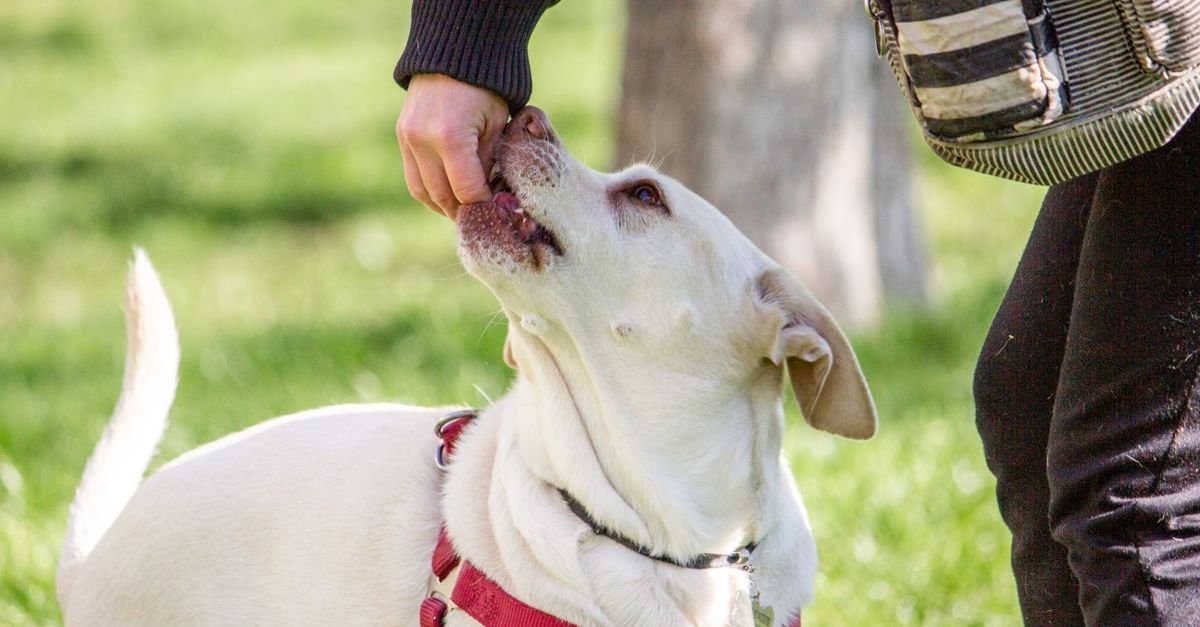
Training changes behavior through learning. When a behavior reliably produces something valuable—food, play, access to a person, movement, or relief from a manageable situation—it is more likely to occur again. Training can build behaviors such as checking in, walking on a loose leash, settling on a mat, coming when called, trading an object, or moving away from a trigger.
Training also changes the dog’s expectations. A dog that learns “looking at a bicycle makes chicken appear” may begin to look toward the owner instead of immediately lunging. A dog that has practiced relaxing on a mat may find it easier to settle when visitors arrive. These improvements do not necessarily remove the original motivation; they give the dog a rehearsed alternative.
Reward-based training is the most useful general starting point because it teaches the dog what to do without adding fear or pain. AVSAB recommends reward-based methods for dog training, including behavior problems.[6] Rewards should be matched to the individual dog: food, tug, sniffing, access to a favorite place, and social interaction can all be valuable depending on the context.
Why two dogs raised alike can behave differently
Even dogs from the same litter can differ because they do not have identical genetic variation, prenatal experiences, sensitivities, learning histories, or relationships with people. They may also notice and respond to the same household event in different ways.
Consider two dogs that bark when someone approaches the front door. One may be excited and seeking access to the visitor. Another may be worried and trying to increase distance. The visible behavior is similar, but the motivation and best training plan are different. Management may include blocking the window, moving the dog away from the door, and using a practiced station behavior; the reinforcement plan should reflect whether the dog needs calm access, distance, or a predictable routine.
This is why labels such as “stubborn,” “dominant,” or “bad” are usually less helpful than specific observations: What happened immediately before the behavior? What did the dog gain or avoid? How intense was the trigger? How quickly did the dog recover?
A practical way to separate influence from responsibility
| Question | What it may reveal | What you can do |
|---|---|---|
| Does the behavior appear across many settings? | A broad temperament tendency, strong motivation, or a well-rehearsed habit | Use management, lower the difficulty, and teach an alternative in several locations |
| Did it begin after one frightening or painful event? | A learned association or possible discomfort | Avoid repeating the trigger at full intensity and seek appropriate professional help if it persists |
| Does it occur only when the dog is overtired, confined, hungry, or highly excited? | Arousal or environmental effects | Improve rest, routine, enrichment, distance, and access to calm behaviors |
| Does the dog improve when rewarded for an alternative? | Learning and reinforcement are influencing the pattern | Practice the alternative before the trigger becomes overwhelming |
| Is the behavior sudden, escalating, or unlike the dog’s usual pattern? | Possible pain, illness, or another major change | Arrange a veterinary assessment rather than treating it as a training failure |
What owners can realistically change
- Triggers and distance: Move the dog farther away, block visual access, change routes, or schedule practice when the environment is quieter.
- Reinforcement: Reward the behavior you want before the dog is already too excited, frightened, or frustrated to learn.
- Rehearsal: Prevent repeated practice of unsafe or unwanted behavior whenever possible. Management is not failure; it protects training progress.
- Daily outlets: Provide appropriate movement, sniffing, chewing, social contact, and problem-solving. Enrichment can be especially useful for dogs whose arousal or frustration makes learning difficult. See our guide to building a better enrichment routine for dog overarousal.
- Clarity: Use consistent cues and reward promptly. If several people live with the dog, agree on the same response plan.
- Expectations: Measure progress by recovery time, distance tolerated, and frequency of safe choices—not only by whether the behavior has disappeared.
For example, success for a noise-sensitive dog may initially mean noticing a sound and eating a treat, rather than remaining completely unconcerned. Success for a dog that barks at night may mean fewer episodes, faster settling, and a better management routine. Our article on reducing nighttime barking covers one specific application of this approach.
When genetics should change your plan
Inherited tendencies should influence planning, not determine whether training is attempted. If a dog has intense chase motivation, use secure equipment and prevent access to vulnerable animals while teaching recall and disengagement. If a dog is naturally sensitive, begin with lower-intensity exposures and reinforce observation from a comfortable distance. If a dog was bred for endurance or work, provide suitable outlets instead of expecting long periods of inactivity to be easy.
Some behaviors require more than a basic obedience class. Growling, snapping, biting, severe panic, repeated escape attempts, or behavior that is worsening despite careful management deserve prompt help from qualified professionals. A sudden behavior change also warrants attention to possible medical contributors. The goal is not to find someone to blame; it is to identify the safest combination of management, training, and support.
The bottom line
Genetics influences what comes easily, what feels threatening, and what motivates a dog. Early experience and environment influence how those tendencies develop. Training shapes the behaviors the dog practices and the consequences those behaviors produce. None of these factors operates alone.
The most productive owner question is not, “Is this genetic or my fault?” It is, “What does this dog seem predisposed to do, what has the dog learned so far, and what can I change to make the next good choice easier?” That framing preserves accountability for safety without turning individual differences into blame.
Sources
- Highly heritable and functionally relevant breed differences in dog behaviour — Proceedings of the Royal Society B
- Ancestry-inclusive dog genomics challenges popular breed stereotypes — Science
- Genetic Characterization of Dog Personality Traits — Genes
- AVSAB Puppy Socialization Position Statement — American Veterinary Society of Animal Behavior
- Influence of early life adversity and breed on aggression and fear in dogs — Scientific Reports
- AVSAB Humane Dog Training Position Statement — American Veterinary Society of Animal Behavior